

Remember to Love
I don’t need a memento mori to remind me I’m going to die

Hello, Lovers & Fighters!
I have two releases to remind you about! If you’re not interested, feel free to scroll down to the essay.
First, Kaiju Haiku is out! This is a comic that I illustrated, lettered, and designed the cover and interior for, but I did not write it. The very talented Chad Ellis Boykin wrote some deeply moving small poems about these giant monsters. The book is available just about everywhere books are sold. You can click here to find it in your favorite retailer.

Second, my latest zine, Deconstructed Numbers, is available on pre-sale only through my Weirdo Poetry Shop. It goes live August 3rd. The special Zine Club version has already been sent out to Zine Club Members. This zine is a collection of experimental poetry comics. There are plenty of haiku comics, but there are also many other kinds of poems included. Click here to pre-order the retail version, or I will send you the exclusive Zine Club version when you join!

And now on with the show!

Remember to Love
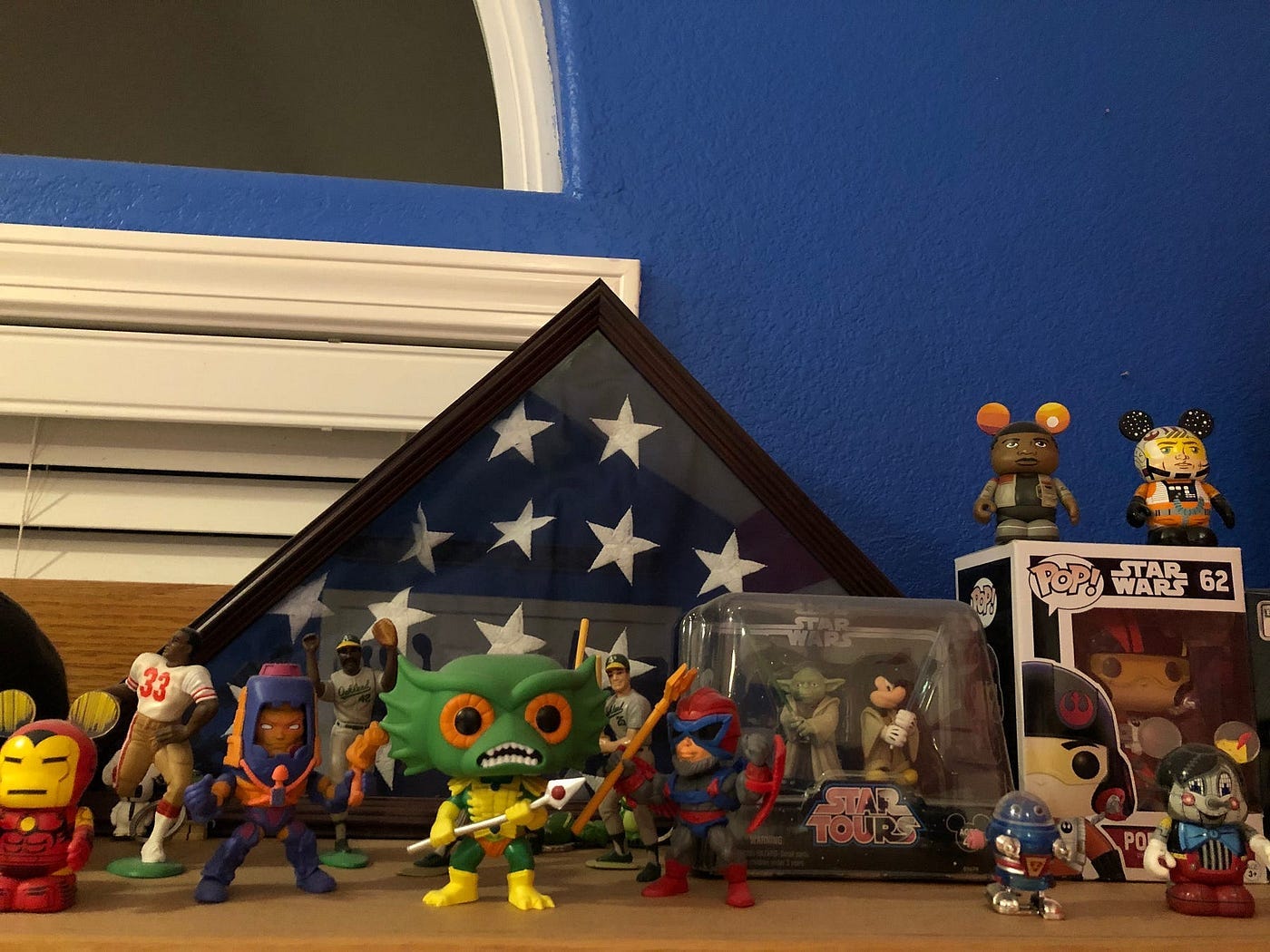
Tokens and talismans surround my desk.
My army of desk guardians forms ranks on the credenza, making a defensive line against writer’s block, and ready to storm the accounting department of any client who unwisely dithers in the payment of my invoices.
On the main part of my desk, below my monitor, are a handful of knick-knacks, each waiting for a turn to be fiddled with. I never fiddle with them while writing. They are only there for the editing process, and to keep me from gouging my eyes out on business calls.
Usually, I reach for my fidget cube because it presents the most options. But lately, I’ve taken to the Hawaiian poker chip that mysteriously turned up in a box of bookshelves we ordered online several years ago. I love turning the smooth edges in my fingers. I imagine this poker chip would be my marker if I were to find myself in the same black-market dream-hopping business as Leonard DiCaprio’s character in the movie Inception.
Next to the poker chip, there are two unusual seashells I found in the beach near Depoe Bay, a piece of petrified wood I bought in a fossil and rock shop in Lincoln City on a family trip, some rocks my kids have given me, and a half a chestnut that my child found on Valentine’s Day a few years ago that is in the shape of a heart.
The most important token on my desk is found just to the right of my monitor.
It’s a paperweight. It’s a bunch of screws, nuts, and washers glued to a rock and covered in Tin-Man-silver paint. It’s clearly the work of a child.
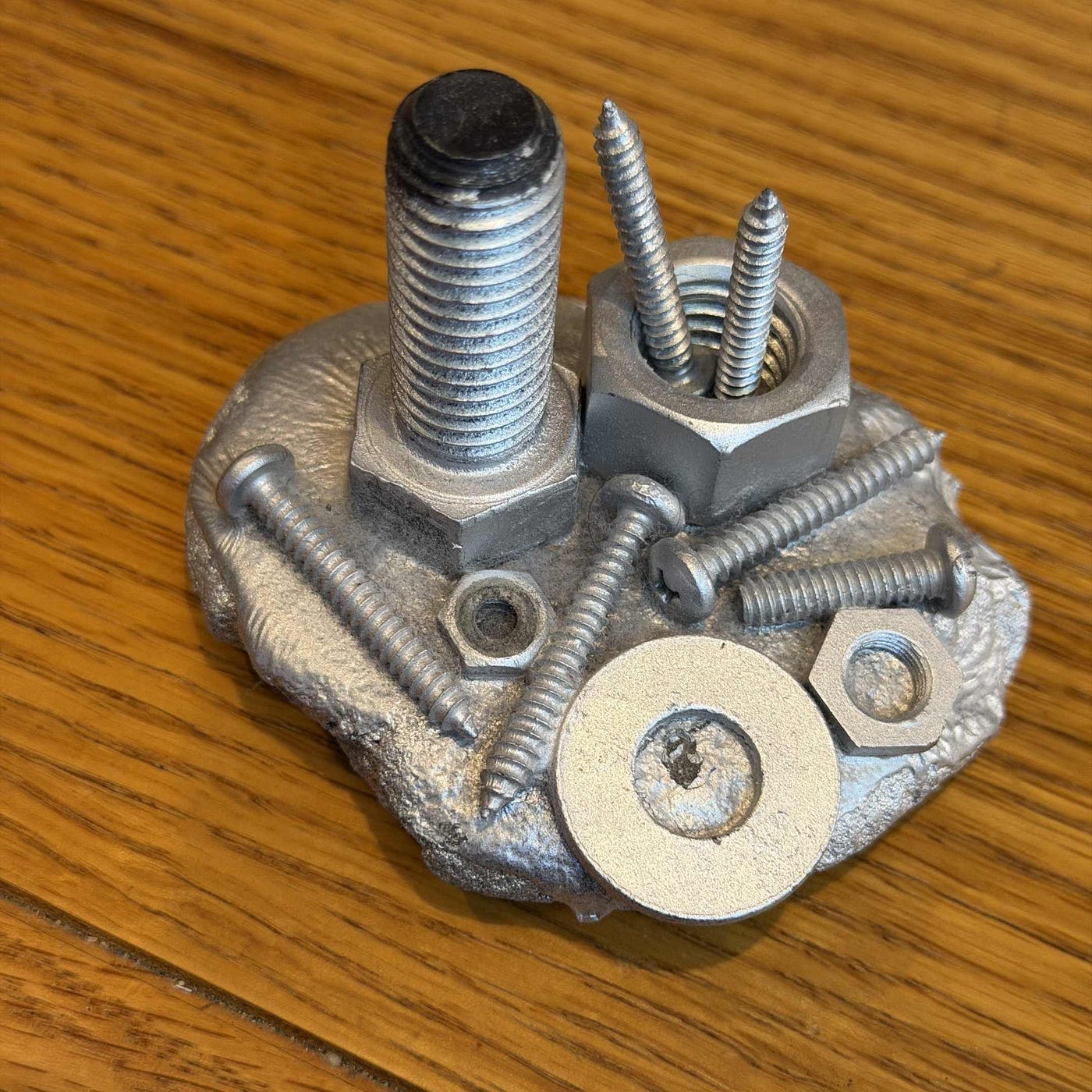
My niece gave it to me more than a decade ago, the first Father’s Day after her dad died.
Her dad was my wife’s brother. He died an ignominious death, even by the standards of an alcoholic.
The paperweight isn’t about him. It’s about his daughter.
Her teacher knew the girl’s dad had died. Everyone did. And in the way that everyone knows when someone’s marriage broke up because of an affair, everyone knew how her dad died.
The tradition was to make Father’s Day gifts at the end of the school year. Even though not everyone has a dad, even though the world-changing calamity for one girl was still raw and pulsing, and even though most of the kids and their fathers would never remember the paperweights, the traditional project had to go on.
It seems cruel that this little girl had to sit and listen to directions about how to make the Father’s Day project. She had to listen to her classmates get excited about the prospect of their dads opening their precious gifts. Every day they worked on the project was another reminder that for the rest of her life Father’s Day would be hollow and painful.
Her mom told her she should make it for someone else. She decided to make it for me. My niece was only in first grade.
I believe that thinking about someone else made it a little easier to get through the project, to get through the end of the year.
On Father’s Day, she handed me a heavy, bulky present, wrapped precariously in tissue paper.
I smiled when I opened it and thanked her. She hugged me. I wanted to cry, but I knew that crying right then wouldn’t help. I just smiled.
When I got home, I put the paperweight in the garage by my workbench. That didn’t feel right.
I moved it inside where I would see it every day.
Then I cried.
In some of the online circles I stalk, it’s fashionable to buy a brass coin with a skull and the Latin words “Memento Mori” carved on one side. The Latin means remember you must die.
The idea is that if you are conscious of your mortality, you will make better decisions. You will be less likely to daydream your life away. Instead, the coin will keep you rooted in the present. Some Stoic philosophers carried around such tokens, and they came to be known as memento mori. The coins are a modern capitalistic take on the ancient ideal.
I pity the people who need the coins. They have a lot of heartbreak in their future. If they need a token to remind them of their mortality, they have been sheltered from the painful vicissitudes of life that must fall to each of us. But their time will come. It comes for all of us. It just comes for some of us so much younger than it is fair or right or just.
The paperweight sculpture is a much more visceral memento mori than a $40 coin. It sits just inside my peripheral vision. I see it when my concentration breaks.
When I see it, I don’t just remember that I must die. I remember that everyone I love must die. That is much more sobering. What would my death mean? To the world, it will mean little. But any day, one of my loved ones could die, or they could lose me. Whenever Death comes to sever our mortal bond, I want them to know that they were my world.
The paperweight reminds me to tell people how I feel about them and to never forgo the chance to help a child with their bike, to play a video game together, or to watch some new trick they’ve almost mastered.
The paperweight also reminds me that we live in a world where indifference can be cruelty and that sometimes a simple change in focus is enough to help us get through a difficult task.
My niece just got married this year, living far away. She saw the paperweight a few months ago when she was over at our house for a visit. She looked at me and smiled. She asked me if that was the one she had given me.
I nodded and told her it was.
She smiled again and said, “That’s cool. “
That was all that needed to be said.
It is the most important token on my desk. It is a token of the power of love to overcome anything, even the pain of having someone you need die before you’re ready for them to leave.
It’s also a talisman of hope; the hope of a future where the throbbing of the pain from your loss dulls enough to let you feel joy again.
Maybe the paperweight isn’t really a memento mori at all. Maybe it’s a memento amare. A reminder that we all must love.

Thanks for reading! Be the weird you want to see in the world!
Cheers,

I never taught the kids it affected, except bar one where my student's sister committed suicide, but there many deaths in my Polish school this year. Thank you Jason, this helped me in a way I wasn't even able to do with my own poems:)
<3<3<3