


Hello, Haikuistas!
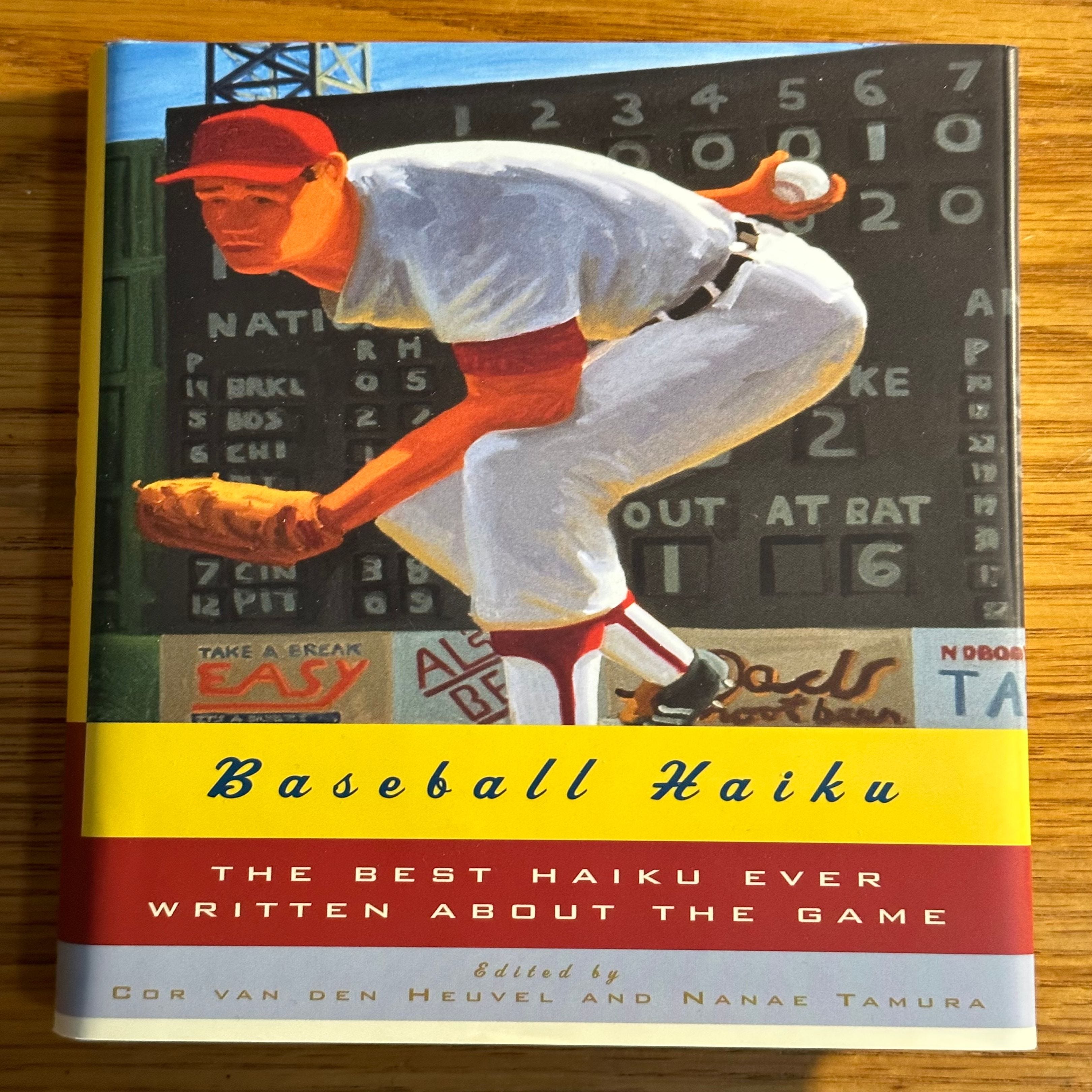
After an unplanned hiatus, The Asynchronous Poetry Book Club is back! This month, we will be working our way through the haiku anthology Baseball Haiku, edited by Cor van den Heuvel and Nanae Tamura.
Normally, Asynchronous Poetry Book Club posts are behind the paywall. However, since it’s been a while since I posted one of these, this one is free for everyone!
Reading Haiku
We’ll start this week with me reading a selection of baseball haiku written by American poets.
Haiku Comic
Why Baseball Haiku?
If you’ve been here a while, you already know that I love haiku in all its forms. If you’re new here, let me briefly explain my haiku philosophy. If you’re a glutton for punishment, you can read about my haiku philosophy in more detail in these two posts:


English Language Haiku is related to Japanese haiku but has become its own distinct poetic form.
There are three main branches of the English Language Haiku tree, each emphasizing different parts of the Japanese tradition. I hold that almost no English Language Haiku follows all of the traditional Japanese haiku rules. Instead, each branch ignores some rules while emphasizing others.
One branch, we’ll call it the free verse haiku branch, rejects the 5-7-5 constraint to focus on all of the other constraints, with a special focus on nature and a poem that can be read in a single breath. These haiku are incredibly compact and potent, often conveying deep meaning in ten or fewer syllables. Jack Kerouac and Cor van den Heuvel are excellent examples of great poets from this branch.
The second branch, which we will call the formal haiku branch for lack of a better term, ignores the idea of a poem that can be read in a single breath and focuses most heavily on the 5-7-5 constraint. Richard Wright, my favorite American haiku poet, is a part of this branch. Mark Strand, the haiku editor of Tricycle, is another great poet from this branch. I mostly write haiku in this tradition, though I have no animosity for haiku poets in any other tradition. Most of the poems I highlight as part of the Asycnronous Poetry Book Club belong to the free verse branch.
The third branch holds something to be a haiku so long as it follows the 5-7-5 pattern, regardless of the content of the poem. This branch does not worry about season words or writing about nature, and wabi-sabi may only be of passing interest. I also write a fair amount in this tradition as part of my mission to help more people overcome their fear and anxiety around poetry.
What does all of this have to do with Baseball Haiku? Adding baseball as an official season word in Japanese for haiku shows that this ancient form can still adapt to an evolving world. To me, it also shows that many of the “rules of haiku” are arbitrary and that English Language Haiku can benefit from a loosening of its formality in terms of subject matter and structure.
But that’s enough blather from me. Onto the poems!
Selected Poems & Random Thoughts
Bud Goodrich
Manager, umpire
     shadow-boxing
          jaw to jaw
This is a perfect poem. Not a wasted word. Right now, you see this drama playing out in your mind’s eye, and Bud Goodrich conjured all that for you with just six words.
I am also fond of the shape of this poem, with each line moving in from the margin as each line gets progressively shorter, and each line looking like a faceoff between two words. First, the manager and the umpire are only separated by a polite coma. The next line has shadow and boxing squaring off with only a hyphen holding them apart. Finally, line three brings us jaw to jaw, with “to” feeling less like a word and more like a strong punctuation mark doing its best to keep the two words on either side from erupting into violence.
Jack Kerouac
Empty baseball field
  —A robin,
Hops along the bench
I am a sucker for birds, and I love the imagery of seasonal birds like robins and geese paired with the great season sport of baseball.
Kerouac experimented a lot with different punctuation and capitalization conventions with his haikus, or pops, as he called them. You can often tell the approximate era a Keroac haiku was written by the way he capitalzies or doesn't capitalize each line of the poem.
Helen Shaffer
drooping flag…
the visitors' manager
moves a fielder
This poem captures what I love about baseball—and what my children and so many people under age 30 despise about the game—its languid pace and its endless strategic and tactical minutiae.
I love how we know the weather conditions by the drooping flag, and if you know baseball, you understand why the manager needs to move a fielder. Once again, haiku shows its unrivaled poetic power to communicate so much in so few words.
As a punctuation nerd, I also enjoy the use of an ellipsis at the end of the first line to signal a transition instead of a comma or a period. It gives the poem a more fluid feel.
Cor van den Heuvel
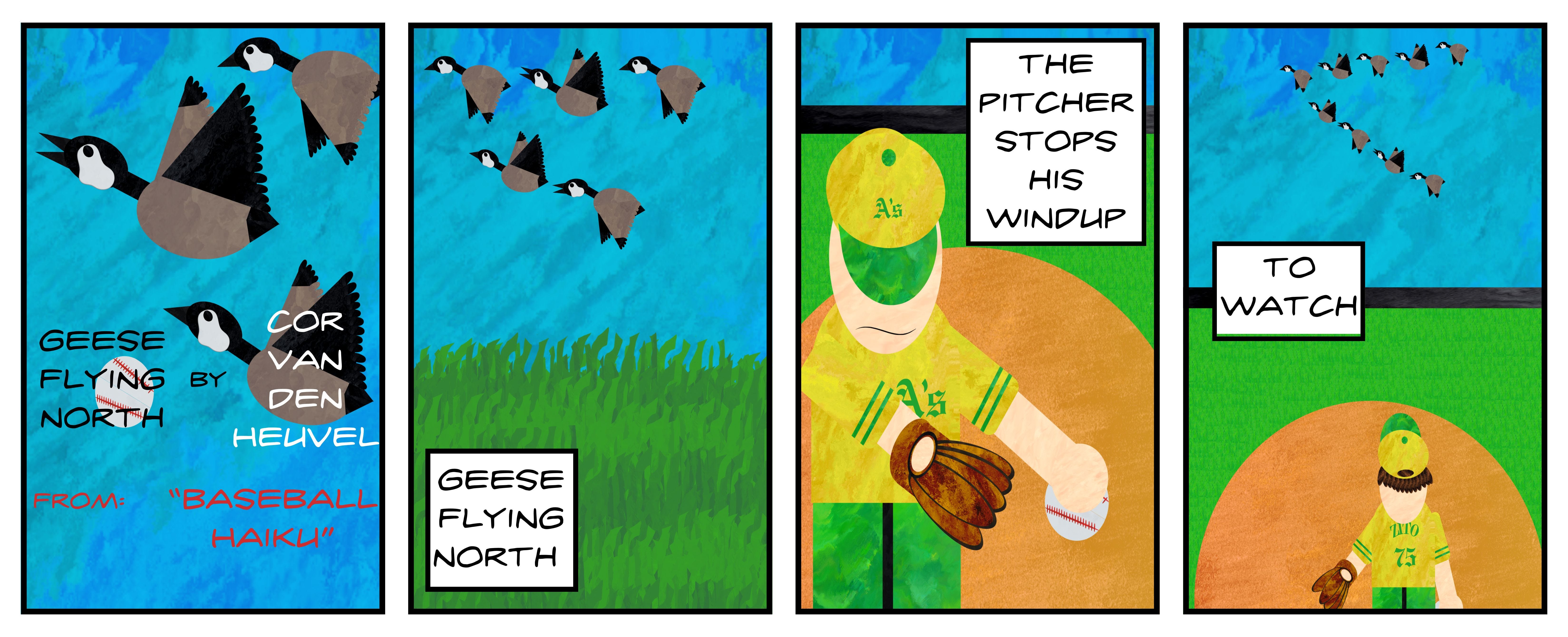
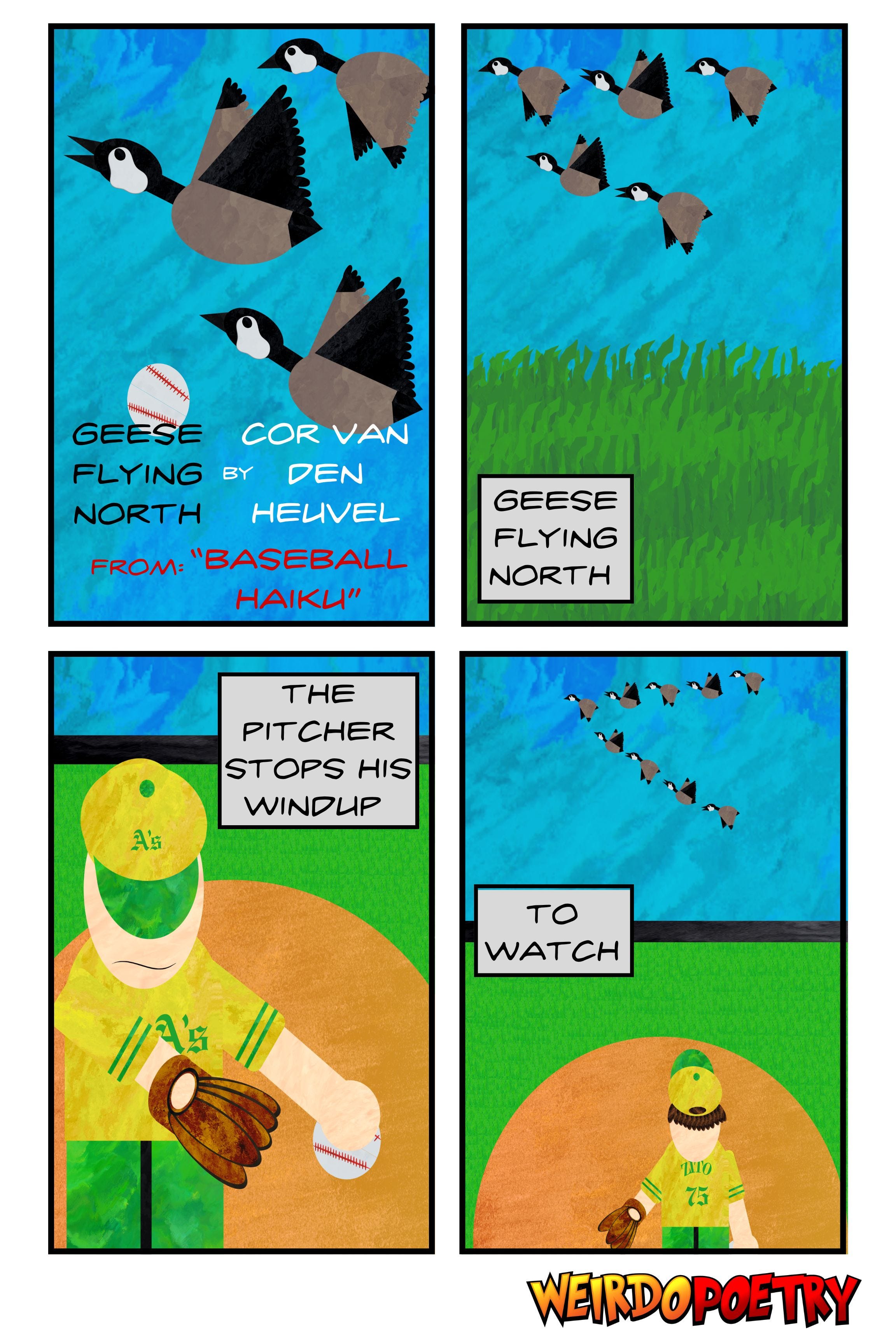
geese flying north
the pitcher stops his windup
to watch
What can I say? I love any baseball player who stops to watch the geese flying overhead. I also love the subtle touch of geese flying north. The geese, like the pitcher’s opponent, are trying to get home.
baseball cards
spread out on the bed
April rain
I loved collecting baseball cards and stickers but was never burdened with owning any cards that had any large financial value.
Early on in my haiku writing career, I was persuaded to change the way I use capitalization in my haiku by the way Cor van den Heuvel works. I also only capitalize proper nouns like April and start each line with a lowercase letter. I still find this way of working more elegant and modern to my eye than capitalizing the start of each line.
conference on the mound
the pitcher looks down
at the ball in his hand
I sometimes read this and feel the pitcher is determined to finish the inning and get this last batter out. Other times, I read these lines and see a pitcher who knows he is getting pulled and is so despondent about his fate he cannot look his catcher or manager in the eyes.
Either way, this poem paints a stirring drama.
Raffael de Gruttola
I neglected to read these two haiku in the video, but I think they are fantastic and very emblematic of the concept of wabi-sabi.
lost in the lights
the high fly ball that
never comes down
puddles
in the batter's box
abandoned sandlot
You can feel the bittersweetness of these poems in your bones.
Sylvia Forges-Ryan
waiting to bat
the hitter swats
a swarm of gnats
I love how playful this haiku is. It’s a great reminder that poetry and writing are supposed to be fun, not torture. This poem also reminds me of my little league days in Aloha, Oregon, where we always seemed to be playing near some kind of wetland and were besieged with gnats on more than one occasion. Often my time in the on-deck circle was spent swinging at gnats more than preparing for my chance to strike out.
rained out
the coos of pigeons echo
in the empty stadium
Baseball wouldn't be the same without the occasional rainout. Outdoor baseball keeps us connected to the weather and the rest of nature in a way our phones do not.
Arizona Zipper
Hopping over the mound
    and into the dugout—
          the first robin.
I love how Arizona Zipper conveys the sense that anything can happen in a baseball game because it’s played outdoors.
A harvest moon
    every eye turned
         to a running bunt.
This haiku is pure baseball perfection paired with poetic pureness and precision I am still seeking in my own work. What a wonderful scene!
Bottom of the ninth
    in the dugout
         a row of bent heads.
When I was six years old, my grandparents came to visit us in our new home in Aloha, Oregon, a suburb of Portland. They lived in Idaho, where my sister, our parents, and I were born. We had just moved to Oregon from Colorado earlier that year.
The seventh game of the World Series was on TV. My grandparents and younger sister were rooting for the Cardinals while my parents and I cheered for the Brewers. My parents always cheered for the underdogs, and the Brewers had once been the Seattle Pilots, which made them sort of connected to our new home state.
The Brewers lost, and I remember how crushed the players looked in the dugout and how I was overcome with more feelings than my six-year-old body could handle. This haiku brings all of that back to me.
The haiku is not much more than a simple sentence, yet it carries all the emotional freight of a real loss sustained in real life or on the baseball diamond.
Do you have any favorite baseball haiku? What did the poems we read together this week make you feel? I’d love to hear from you in the comments.
Remember, this is an asynchronous book club, so if you are just coming upon this post days, weeks, months, or even years after it went live, leave a comment. I’m still around and am always in the mood to talk haiku!
Be the poetry you want to see in the world!
Cheers,

P.S. I will share some of my baseball haiku in the form of haiku comics before the end of August.
The Goose home run! Gorgeous comic!
You did so well with these, Jason, and I enjoyed your reading and text very much - enhanced even more by a picture of Cor’s book.
I shared your link with my haiku friends during our Zoom meeting, and they appreciated it very much.
Please let me know when you will be doing your next Baseball Haiku reading and, if you can, send me a link as you did this morning.
Many thanks,
Arlene